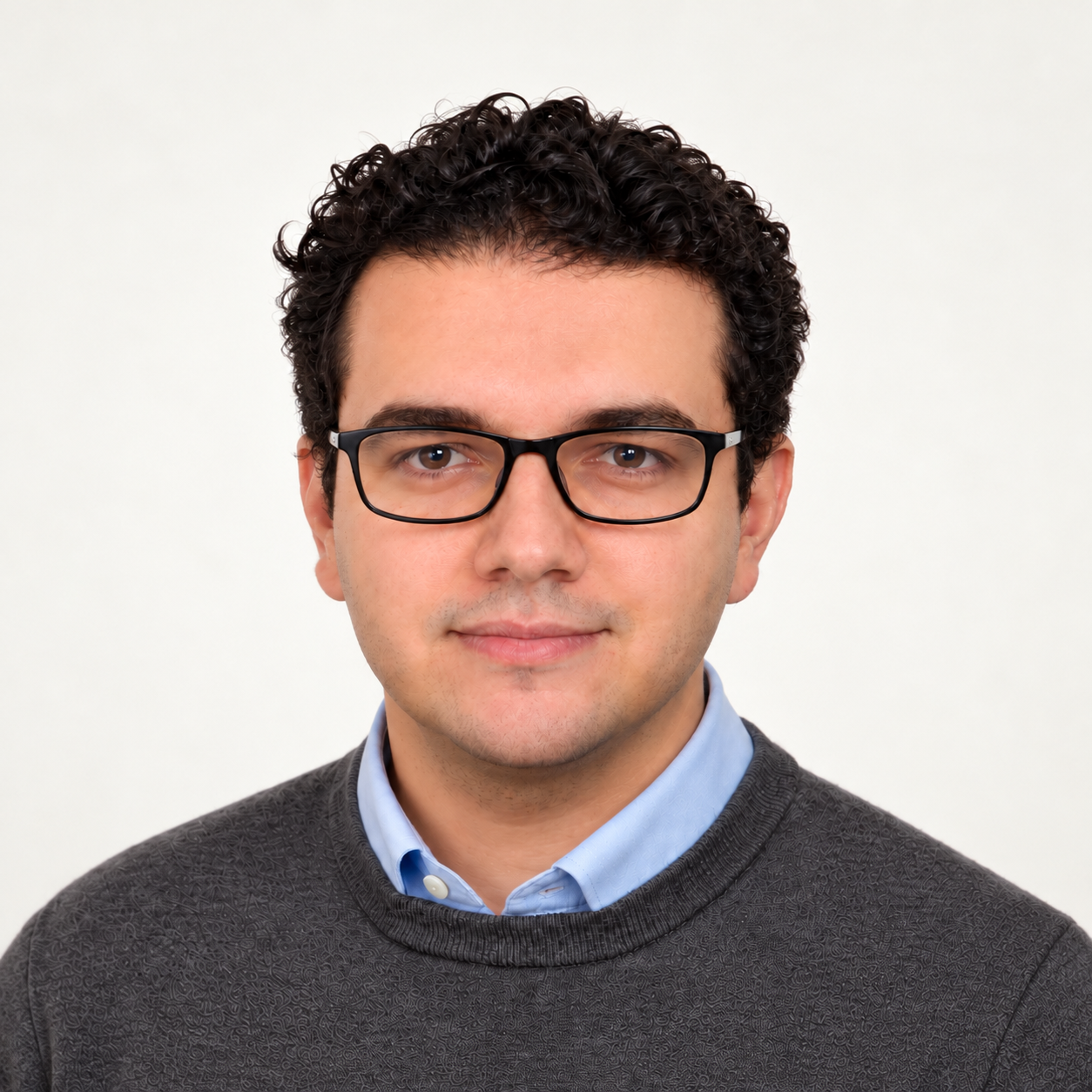
Portrait of Nabil Ahmed

Nabil Ahmed

(he/him)

Postdoctoral Fellow

Molecular and Computational Biology

Germany

Professional summary

I am a molecular and cellular biologist with a doctorate (Ph.D.) in biochemistry and molecular immunology, and I have recently added computational biology to that foundation. My work focuses on the cellular mechanisms that sustain cancer cells and on how those mechanisms can be targeted, combining immunology and cancer biology with training in bioinformatics, biostatistics and data analysis.

Download CV (PDF)

Updated September 2026

Research interests

Directions I want to work in, alongside the methods I already use.

Molecular Biology

Cellular stress and homeostasis, mitochondrial function, RNA splicing, single-cell interactomes.

Computational Biology

Quantitative proteomics, single-cell and spatial transcriptomics, NGS workflows.

Cancer Immunology

Tumour microenvironment, immune cell and tumour interaction, barcoded CAR T-cell screens, immunotherapy.

ORCID 0009-0007-1252-2956 is the authoritative record of my publications. Please use it when citing or linking to my work.

Positions and training

  1. August 2025 — present

    Applied Bioinformatics and Biostatistics

    CQ Mplus Academy, Berlin, Germany

    • Programming in Python and shell, object-oriented methodology.
    • Bioinformatics resources and databases: NCBI, Biopython, SQL, web services.
    • Sequence and structural analysis, NGS workflows in Galaxy and Snakemake.
    • Applied biostatistics in R: ANOVA, PCA, HCA, multivariate methods, Bioconductor workflows.
  2. October 2024 — April 2025

    Postdoctoral Fellow

    Goethe University Frankfurt, University Hospital Frankfurt, Department of Hematology

    • Established a CROP-seq screening system with cytosine and adenine deaminase base editors for single-cell readout.
    • Analysed TMT-labelled quantitative proteomics data from mass spectrometry, including internal reference scaling across plexes.
    • Co-developed REEF, a Shiny application for disease-level CRISPR dependency and expression signatures.
  3. July 2019 — October 2024

    Ph.D. (Dr. rer. nat.) in Biology

    RWTH Aachen University, Institute of Molecular Immunology and Biochemistry

    • Thesis: analysis of the IRE1 interactome using TurboID proximity labeling in the human mast cell leukemia line HMC-1.2.
    • Member of an RWTH Start-Grant funded Research Training Group.
    • First-author publication in Cells; contributing author on a mast cell inhibitor study in European Journal of Immunology.
  4. March 2018 — June 2019

    Medical Technical Assistant

    Ulm University, University Hospital Ulm, Institute of Immunology

    • Immunophenotyping by flow cytometry on BD FACSCanto and LSRFortessa.
    • Colony management and isolation of bone marrow and splenic B cells from genetically modified mouse models.
    • Genotyping by PCR; contributed the in vivo work behind a CLL study in Haematologica.
  5. October 2015 — December 2017

    M.Sc. in Molecular Bioscience

    Ulm University, Institute of Neurobiology

    • Thesis: immunophenotype and downstream signalling of the suppressive ectonucleotidases CD39 and CD73 in primary glioblastoma cells.
  6. September 2009 — May 2013

    B.Sc. in Biochemistry and Microbiology

    MNF University, Egypt

    • Thesis: degradation of IL-2 by Pseudomonas aeruginosa proteases and its effect on host immune responses.

Position Degree Structured training

Research and software

Code is on GitHub.

REEF: disease-level signature explorer

With Dr. Burak Demircan, Hematology and Oncology, University Hospital Frankfurt

Pools cell lines belonging to one disease and extracts the signature they share: commonly and selectively essential genes from CRISPR screens, plus consensus up- and down-regulated genes from expression data. Scoring combines effect size with cross-line consistency, so single-line outliers do not dominate.

Manuscript in preparation.

  • R
  • Shiny
  • CRISPR screens
  • DepMap-style data

TurboID interactome pipeline

RWTH Aachen, Institute of Molecular Immunology and Biochemistry

Analysis pipeline for TurboID and BioID proximity-labeling proteomics: contaminant handling, enrichment against the appropriate labeling control, statistical testing and interpretation of proximal interactors.

Underlies the IRE1 interactome published in Cells (2024).

  • R
  • Proteomics
  • Mass spectrometry

Base editing screen with single-cell readout

University Hospital Frankfurt, Department of Hematology

Built a CROP-seq system for cytosine and adenine deaminase base editors, from vector design and viral transduction through to editing validation, so that guide identity and transcriptome can be read out from the same cell.

Screening system established and handed over; wet-lab work, not yet published.

  • CRISPR base editing
  • CROP-seq
  • Lentiviral transduction
  • Cloning

TMT proteomics with internal reference scaling

Training project, University Hospital Frankfurt

Worked through a multi-plex TMT dataset carrying a pooled reference channel and deliberate plex-level batch differences, to show why internal reference scaling is required before any cross-plex comparison is meaningful.

Documented as a reproducible walkthrough.

  • R
  • TMT
  • Batch correction

flowGateR

Independent tool

Scripted gating workflow for flow cytometry in R, written to make gating decisions explicit and repeatable rather than clicked through by hand in a GUI.

Grew out of several years on FACSCanto and LSRFortessa.

  • R
  • Flow cytometry
  • Reproducibility

Mitochondrial DNA NGS workflow

Training project, CQ Mplus Academy, Berlin

Snakemake workflow for mtDNA sequencing from blood samples, covering read processing through variant calling with the steps and dependencies declared rather than implied.
Reusable across sample batches.

  • Snakemake
  • Python
  • NGS

Publications

Full list on ORCID and Google Scholar.

Skills

Molecular and cell biology

PhD at RWTH Aachen, fellowship in Frankfurt

  • Molecular cloning
  • Protein pulldown
  • Proximity labeling (TurboID, BioID)
  • 2D and 3D cell culture
  • Lentiviral transduction
  • ELISA
  • CRISPR/Cas9 and base editing

Immunology and in vivo work

Institute of Immunology, Ulm; FELASA B licence

  • Flow cytometry (FACSCanto, LSRFortessa)
  • Immunophenotyping
  • Mouse models
  • B cell and mast cell biology
  • Genotyping PCR

Computational

Published analyses, open repositories, ongoing training

  • R (advanced)
  • Python (intermediate)
  • Bash (intermediate)
  • Git and GitHub
  • Bioconductor
  • Snakemake
  • SQL

Data analysis

Proteomics and screen data from own projects; single-cell and spatial methods in training

  • Quantitative proteomics (TMT)
  • Internal reference scaling
  • CRISPR screen analysis
  • Differential expression
  • PCA and multivariate statistics
  • Single-cell RNA-seq (Seurat, in training)
  • Spatial transcriptomics, lymph node Visium (in training)

Other

Doctoral training and supervision

  • Scientific writing
  • Grant preparation
  • Student supervision
  • English (proficient)
  • German (proficient)

Contact

The fastest way to reach me is email. I read everything, and I reply to anything that is not automated.

The CV above is the full version. This page also prints cleanly with Ctrl+P or Cmd+P. References are available on request.

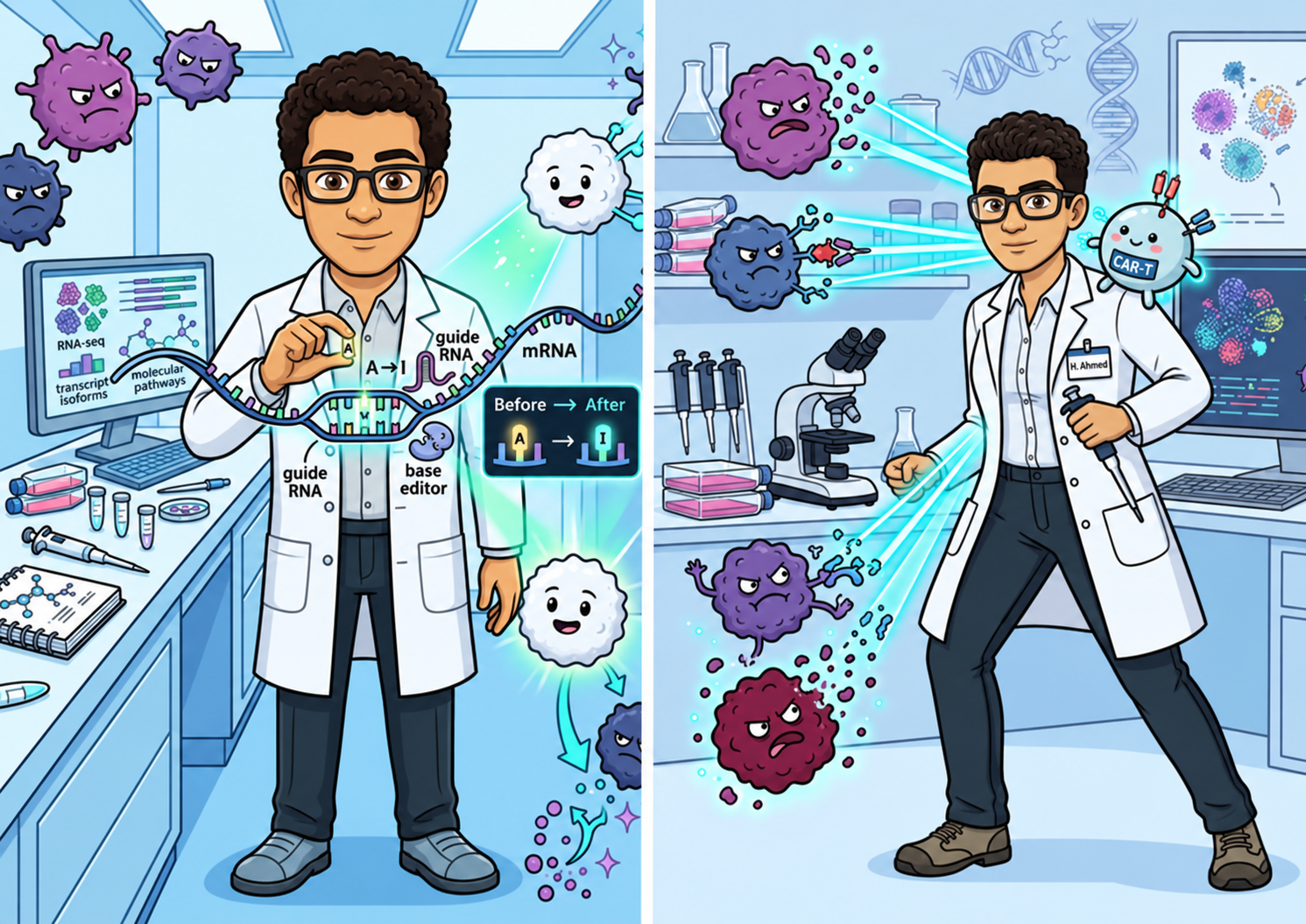
Two cartoon illustrations of Nabil Ahmed working in a laboratory
Illustrations, not experimental data.